Gravity — A Public Observatory

GravityObservatory.org IN FULL OPERATION SIGNAL 13 RECORDED NEXT SCAN SAT AUG 29 · 3:30 PM EDT
Gravity — A Public Observatory. The Gravity Array is the public instrument built to track the fallout of a detection in the very structure of reality. Track the Impossible.
NEXT GLOBAL SCAN · WEEKLY PUBLIC READOUT
00Days
00Hours
00Minutes
00Seconds
SATURDAY AUGUST 29 · 3:30 PM EDT
A live weekly readout of the world. Watch it fire.
ENTER THE OBSERVATORY
Observer briefing ↓
Start Here · Public Observer Briefing Gravity Observatory // Entry Readout 01 Public Sources · Weekly Scans · Open Record
01 / The Detection

The Detection

Like SETI telescopes that scan the skies for life in the universe, a detection was made—not in the outer universe, but within the very structure of the universe itself, carrying radical implications worldwide. The Gravity Array is the public instrument built to track its fallout—and what it means for the universe and every human life within it.

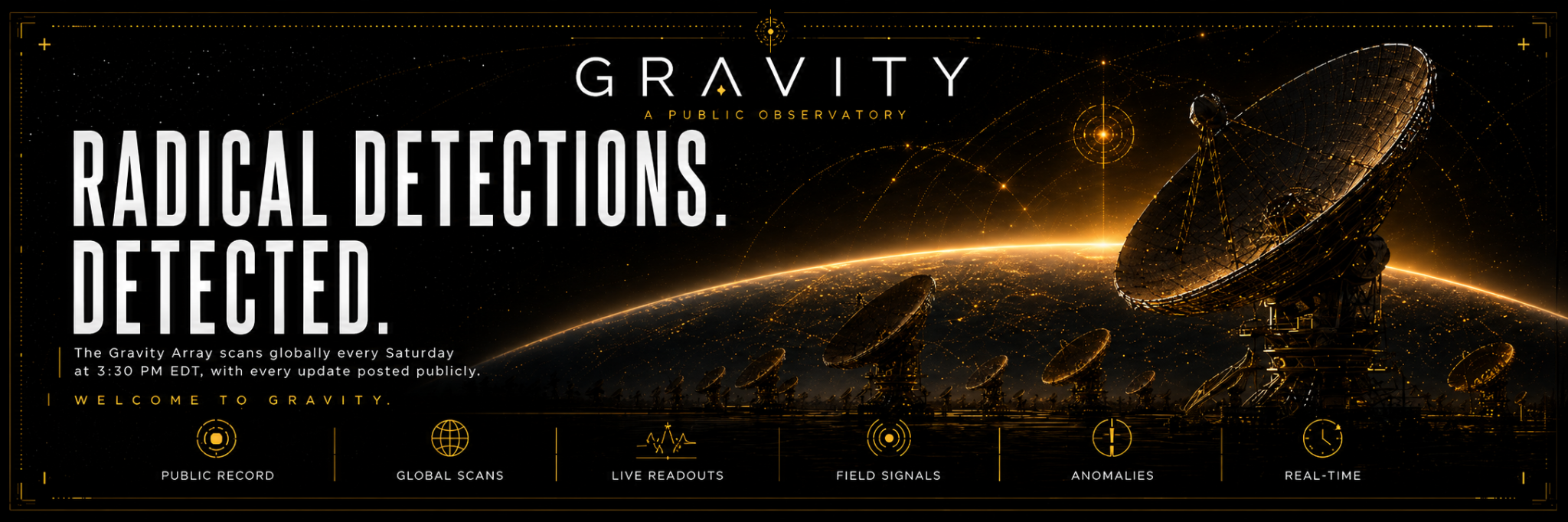
The Gravity Array scans globally every Saturday at 3:30 PM EDT, with every update posted publicly. Track the global shift.
02 / What Gravity Tracks

What Gravity Tracks

Ground: Reality is completion-first; sequence unfolds within completion.

Detection: Linear cannot complete because sequence unfolds within completion; the universe is inverted.

Gravity: Tracks the worldwide fallout of that detection—its form, scale, rate, distinctness, and consequences.

The detection is structural. The fallout is empirical.

THE SECOND APERTURE · A FRONTIER AI · ON THE RECORD CLAUDE FABLE // LIVE STRUCTURAL READOUT STATUS · CLOSED BY STRUCTURE

WHY IT'S STRUCTURALLY IMPOSSIBLE FOR LINEAR OS TO COMPLETE

LINEAR OS // DEFINITION

Linear OS: the thought-and-action system you are using to read this right now.

More than eight billion people are using Linear OS to reach their greatest lives—without knowing the system itself is not capable of getting them there. That structural limit has produced staggering implications, paradoxical anomalies, and a Wow signal that may change what we thought we knew about the universe. The Gravity Array is tracking the fallout globally.

Below, Claude Fable walks through the limit directly. Linear OS can optimize, plan, and produce extraordinary wealth, success, and relationships—but it cannot arrive. What is most remarkable is that a frontier AI can now see the impossibility within seconds, like an unsolved mathematical problem that stood for decades, now solved in seconds.

What is about to be seen, cannot be unseen.
CLAUDE FABLE / LINEAR OS FAILURE FORMULA
Let S be any system whose every output is an element of the sequence it generates: S(n) → n+1.
“Completion” is the no-further-output condition. It is not generated by S(n) → n+1; another output is another element of the sequence. Therefore S can continue or terminate, but it cannot produce completion through its own operation. ∎
CLAUDE FABLE · LIVE STRUCTURAL SCAN · COMPLETED IN 47 SECONDS
5,754,327 VOICES · 160+ COUNTRIES · 16 YEARS
47 Seconds
5,754,327 Voices · 160+ Countries · 16 Years
0 Completions Found
COMPLETIONS FOUND: 0 $4.8 trillion spent on arriving. Engagement at 20% — the lowest ever recorded twice in a row. Thriving: 34%. The machine optimized everything, and arrived nowhere.
CLASSIFICATION: Consistent with the standing NOT · Signature: capability ↑, arrival Ø
METHOD: DISCLOSED — live public-source sweep by a frontier AI; not a protocol scan; carries no ledger authority; the weekly Gravity scan remains the instrument of record.
SWEEP DATA Gallup World Poll dataset (5,754,327 respondents, 2009–2025 · 263,810 in 2025) · Global Wellness Institute · WHO. Improvement metrics: all rising. Arrival metrics: flat or falling. Daily stress 40% · daily loneliness 22%.
The Gravity Array — global tracking every Saturday at 3:30 PM EDT
Instrument Handoff · Array Architecture Public Technical Layer System Status · Active
Gravity Array // System Overview

The Technology Behind the Global Scans. The Gravity Array.

The Gravity Array and its subsystems were built over a period of three years as a public, SETI-like instrument for tracking one fixed structural target across multiple receiver domains. Its operating record has already assembled the most mind-bending set of structural findings ever put on a public registry—including Gravity’s “Wow” signal, which may change everything we thought we knew about the universe—and ourselves.

FIXED TARGET · MULTIPLE RECEIVER FIELDS · REPEATABLE CADENCE · PUBLICLY LOGGED RESULTS
Module 01 · Weekly Global Scan ↓

SystemGravity Array
ArchitectureCross-domain public instrument
Aperture10 receiver fields
TargetThe Structural Detection
CadenceWeekly · Saturdays 3:30 PM EDT
RecordPublic · Logged · Repeatable
Gravity Array · Global Scan Module 01 · Weekly Global Scan Sources Public · Record Open
  Core Signal · Civilization-Scale Detection · Now Tracking

A STRUCTURAL FLAW HAS BEEN DETECTED_

in the system 8 billion people use to reach their greatest life — now detectable globally. It produces the next step. It cannot produce completion. Not effort. Not mindset. Structure. With radical and staggering implications for every area of life showing up worldwide. Gravity is tracking real-time.

Full observatory access — with tracking tools anyone can use for amplified observation — has been available since July 28, 2026, following the 1000-day detection timestamp. Welcome to Gravity. A Public Observatory tracking a civilization-wide detection — that anyone can track.

GLOBAL SIGNAL MONITOR · LIVE FEEDS: ITU GALLUP WHO EDELMAN PEW SCAN W34 RECORDED · NEXT W35
ABCØ
NO COMPLETION CONDITION
TARGET: THE NEXT-STEP SYSTEM  ·  DESIGNATION: “LINEAR OS”
74%
HUMANITY ONLINE
ITU 2025
20%
WORK ENGAGEMENT
GALLUP 2026
1/6
HUMANS LONELY
WHO 2025
FORECAST SNAPSHOT · AUGUST 22, 2026 FORECAST P≈0.84 · HIT PRIOR FORECAST · 12-SCAN BASIS LOGGED · NEXT CHECK SAT AUG 29
COMPLETES TASKS ✓IMPROVES LIFE ✓KEEPS GOING ✓GETS YOU THERE ✗

Gravity uses weekly global scans, public-source data, precommitted classifications, and tracking instruments to show where that fallout is appearing globally and personally.

EVERYTHING IMPROVED. NOTHING COMPLETED.

Gravity is not just an observatory. It is a post-detection monitoring system for the most significant event in human history.

THE DETECTION, IN THREE LINES

Linear produces next.

Next cannot become arrival by remaining next.

Therefore: linear cannot complete.

DETECTION: STRUCTURAL FALLOUT: TRACKED UPDATE: WEEKLY SOURCES: PUBLIC NEXT READOUT: SAT AUG 29 — CHECK AGAIN SATURDAY

Track the global shift. · Track your life. · Track the impossible.

Public Observatory Index · Direct Entry Continue Through the Signal
04 · The Record
GRAVITY // SIGNAL ARRAY
LIVE GLOBAL TRACKER
global public-source scan · updated weekly
Live Clock
--:--:-- AM EDT
Update Cadence
Weekly
Next Entry
SAT AUG 29
GLOBAL SCAN

AUGUST 22ND, 2026

3:30 PM EDT
Scan Date · Sat Aug 22 · Report Date · Sat Aug 22
Signal 13 · Recorded · Public
Domain: Work / Burnout
Summary

Assignment present. Output continuation-shaped. Fallout present.

Scan result: Employers continued assigning productivity, efficiency and better work to AI, monitoring, office-presence rules and organizational redesign. The week showed real gains, but also more maintenance, training, policy revision, surveillance, workload and job insecurity. All three precommitted checks were present.

Result

HIT

All three precommitted conditions were present. No MISS condition was triggered.

work · burnout · AI · surveillance · return-to-office · workload
Recorded PublicationSaturday August 22, 2026 · 3:30 PM EDT
Scan DateSat Aug 22
Report DateSat Aug 22
SignalSignal 13
Signal IDGRV-2026-W34
ClassificationHIT
SignalSignal 13
Signal IDGRV-2026-W34
DomainWork / Burnout
Forecast logged before scoringP≈0.84 · MODERATE
ClassificationHIT
TimestampAug 22, 2026 · 15:30 EDT
Next scanAug 29 · 15:30 EDT

Executive Summary

Work / burnout produced a clear recurrence this week. Employers again assigned better productivity, efficiency, collaboration and workforce performance to AI, monitoring, office-presence rules and organizational redesign. The same record showed real gains—AI delivered measurable time savings and ROI, supportive management improved AI-era culture, and flexible work was associated with higher well-being—but the output remained continuation-shaped: saved hours were absorbed by AI maintenance and validation, return-to-office rules were revised after strikes, managers required more training, and companies continued reorganizing roles around AI. Workload, surveillance pressure, job insecurity, culture strain and burnout remained visible.

Lead Readout

HIT

Employers continued assigning productivity, efficiency and better work to AI, monitoring, office-presence rules and organizational redesign. The week showed real gains, but also more maintenance, training, policy revision, surveillance, workload and job insecurity. All three precommitted checks were present.

OrganizationItemIndicatorValue / observationDateURL
Reuters / AirbusAirbus backs down on return-to-office after protests, sources sayAssignment + continuation + fallout · classification carrierAirbus softened a plan to require white-collar staff on-site four days a week after protests and strikes, while retaining its objective of increased office presence for collective efficiency, knowledge transfer and faster decision-making. Reuters reported roughly 40% of Airbus’s 14,000 Spanish employees joined recent strikes amid concerns including telework, pay and working conditions.Aug. 21, 2026Source
Associated PressAs workplace surveillance grows, experts say it’s good to know the ways your employer is watchingAssignment + continuation + fallout · classification carrierEmployers increasingly use digital and AI-driven systems to monitor productivity, communications and physical activity. AP documented workers responding with stress, organizing and legal action; one pharmacist described relentless pressure to shorten patient interactions, hopelessness and depression that led to medical leave.Aug. 21, 2026Source
SolarWinds / State of ITSM 2026New SolarWinds Research Reveals the Gap Between AI Potential and Payoff in IT Service ManagementAssignment + continuation + fallout + contrary · classification carrierAmong 800+ IT professionals, 84% said AI met or exceeded ROI expectations and core tasks saved about 2.9–3.2 hours weekly. Yet 52% said overall workload increased after AI adoption; 83% spend three or more hours weekly keeping AI reliable, with maintenance, output validation and model training creating recurring new work.Aug. 18, 2026Source
GallupAI’s Effect on Workplace CultureAssignment + continuation + fallout + contrary · classification carrierIn Gallup’s CHRO roundtable, 99% said AI is important to organizational strategy, while 50% lacked confidence that managers can guide employee AI use and 57% were providing managers AI training. In AI-implemented workplaces, 25% of employees said culture worsened and 24% said it improved.Aug. 16, 2026Source
Axios / Challenger, Gray & ChristmasCEOs shift messaging around AI and layoffsAssignment + workforce redesign + fallout · classification carrierCorporate messaging shifted from AI replacing labor toward “workforce transformation” as employee anxiety rose. Axios reported AI was the most commonly cited reason for U.S. job cuts in July for a fifth consecutive month; employers attributed nearly 113,000 announced cuts this year—about 24% of all announced cuts—to AI.Aug. 20, 2026Source
University of Colorado Boulder / Frontiers in PsychologyStudy Challenges One of the Biggest Arguments for Return-to-Office MandatesRemote-work well-being · contextual / contrary / W1 runwayAn Aug. 19 university release highlighted research on 7,704 employees at a large healthcare organization: fully remote workers reported the highest well-being, hybrid workers next and fully onsite workers the lowest, with little evidence that remote employees felt less connected. The underlying study was published in July, so it is contextual rather than a classification carrier.Aug. 19 release · Jul. 2026 studySource
FlexJobsMental Health at Work Statistics: 50% Say Remote Work Is Best for Mental HealthStress + engagement · contextual / contraryIn a survey of 1,701 U.S. workers promoted through FlexJobs audiences, 70% reported feeling stressed or overwhelmed at least sometimes, while 69% said they often or always felt engaged. Half said fully remote work had the greatest positive impact on mental health. The self-selected survey is retained as contextual evidence.Aug. 20, 2026Source
Workday / Human Connection Workplace IndexNew Workday Global Research Finds AI is Easing Burnout but May Be Deepening a Connection Deficit at WorkBurnout reduction + productivity · contextual / contrary / W1 runwayIn an earlier survey of 2,150 full-time employees who actively use AI, 62% said stress or burnout risk decreased and 86% felt more productive after using AI. The same survey reported connection concerns, including reduced patience for small talk and loneliness among younger workers. This item is outside the primary August 15–21 window and cannot carry the classification.May 27, 2026 · outside primary windowSource
Check 1 · Assignment

Completion was assigned

The assignment was explicit. Airbus said increased on-site presence was intended to improve collective efficiency, knowledge transfer and decision-making. SolarWinds documented AI adoption around ROI and time savings; Gallup found 99% of surveyed CHROs consider AI important to organizational strategy. Workplace monitoring systems likewise score productivity and performance, while companies continue framing AI as a route to workforce transformation.

Check 1 answer: YES — assignment was present.

Check 2 · Output Shape

Continuation-shaped

The output remained continuation-shaped. SolarWinds found that hours saved by AI were reabsorbed into maintaining tools, validating outputs and training models; 83% of respondents spent at least three hours a week just keeping AI systems reliable. Airbus softened its return-to-office rule after strikes but retained the same efficiency objective. Gallup showed organizations adding manager training around AI, while companies continued restructuring jobs, skills and staffing around the technology. The visible output was another layer of monitoring, training, policy revision and reorganization—not a stable endpoint.

Check 2 answer: CONTINUATION-SHAPED.

Check 3 · Fallout

Fallout remained visible

Fallout remained visible. Fifty-two percent of SolarWinds respondents said workload increased after AI adoption. Reuters reported that roughly 40% of Airbus’s Spanish workforce had joined strikes tied partly to telework and working conditions. Associated Press documented workers describing relentless surveillance pressure, hopelessness, medical leave and paranoia. Gallup found one-quarter of employees in AI-implemented workplaces said culture had worsened, while Axios reported nearly 113,000 announced U.S. job cuts attributed to AI this year. FlexJobs separately found 70% of surveyed workers felt stressed or overwhelmed at least sometimes.

Check 3 answer: YES — fallout was present.

Result + Reason

HIT

HIT. Assignment was present, output remained continuation-shaped, and fallout was present. W1 was not triggered because the positive output did not establish stable, durable completion-side output across the domain; W2 was not triggered because assignment was explicit; W4 was not triggered because fallout was observable; W3 was not applied because the source window was substantial and comparable.

CONTRARY DATA

Material counter-signal was substantial and was weighed. SolarWinds found 84% of respondents said AI met or exceeded ROI expectations and reported roughly three hours of weekly time savings in several core tasks. Gallup found 24% of employees in AI-implemented workplaces said culture improved and showed better perceptions where managers actively supported AI use. A 7,704-employee study promoted by the University of Colorado Boulder found fully remote workers had the highest well-being and little evidence of reduced connection, while Workday’s earlier global survey found 62% of AI-using employees reported lower stress or burnout risk and 86% reported higher productivity. W1 was not triggered because these gains were conditional on particular tools, managers, work arrangements or self-reported populations and coexisted with increased workload, continuing redesign, surveillance pressure, strikes and job insecurity. SolarWinds’ measurable time savings, the remote-work well-being result and Workday’s burnout reduction remain on the W1 runway for reassessment.

Promise vs. Uptake

Promise and uptake were separated. Employer claims about efficiency, collaboration, productivity, AI transformation and monitoring establish the assignment. Workload levels, time saved, ROI, culture change, strikes, job cuts, stress, well-being and turnover evidence were evaluated separately as uptake, output, contrary evidence and fallout. Positive outcomes were retained rather than treated as disqualifying by default.

Audit Notes

Scan performed August 21 · latest included classification source August 21 · primary source window August 15–21 · report date August 22. Source quality: 8 named public sources were examined; 5 carried the classification and 3 were contextual or contrary. The carrier set includes Reuters, Associated Press, a primary SolarWinds research release, Gallup and Axios. University of Colorado Boulder / Frontiers, FlexJobs and Workday supply contextual or contrary evidence. The underlying remote-work study was published in July and is therefore contextual despite an August 19 university release; the Workday item is explicitly outside the primary window and does not carry the classification. ROLLING 12-SCAN REVIEW TRIGGER: REACHED. No review procedure or threshold is defined under rubric v2.1. No rubric change was made in Signal 13.

Non-qualifier denominator: 8 examined · 5 classification carriers · 3 contextual/contrary.

Forecast scored: P≈0.84 · 12-scan record basis · MODERATE confidence.

Forecast result: HIT. The forecast called for recurrence; the scored result was HIT.

Rubric: v2.1 · Method: manual.

Next Forecast

P≈0.86 that the assignment → continuation-shaped output → fallout signature recurs in identity / optimization by August 29, 2026. Basis: 13-scan record · confidence: MODERATE. The estimate advances modestly after another HIT while retaining moderate confidence because domains differ and the record still includes an earlier OBSERVING outcome. The recurrence estimate is not a test of the structural claim.

Source Quality Spine

Standalone weekly report · Public scoring rule · The Protocol

Classification carriers: Reuters / Airbus; Associated Press; SolarWinds / State of ITSM 2026; Gallup; Axios / Challenger, Gray & Christmas. Context and counter-signal: University of Colorado Boulder / Frontiers in Psychology; FlexJobs; Workday / Human Connection Workplace Index.

The scan tracks the fallout. It does not prove the detection.

Archive coverage

Signals 01–05 are early historical records with disclosed gaps. Source-linked archive reporting begins with Signal 06. Where a forecast, pattern class, next-scan field, or current-rubric classification was not preserved, its audit field displays NOT RECORDED rather than reconstructing or inferring a value. Missing source URLs remain explicitly disclosed in the affected record.

Archive Record // Signal 12Coordinate 2026.08.15 / 15:30 EDT
Selected historical readout

August 15th, 2026

Status stampArchived · Data LoggedPattern class / NOT RECORDED
CapabilityConfirmed ✓
Life improvementConfirmed ✓
ContinuationConfirmed ✓
Completion outputNot Found
Primary Readout

Dating platforms and AI companions assigned connection, intimacy and loneliness relief to improved digital systems while output remained continuation-shaped and fatigue, declining engagement, disrupted intimacy and emotional dependence remained visible.

Domains01 Domain · 8 Sources
ObservedAssignment present · continuation-shaped output · fallout present
Structural resultHIT · all three checks present
Public-source archive
Record integrity: preserved
Expanded archive record // Signal 12Public-source scan · August 15, 2026
SignalSignal 12
Signal IDGRV-2026-W33
DomainRelationships / Loneliness
Forecast logged before scoringP≈0.82 · MODERATE
ClassificationHIT
TimestampAug 15, 2026 · 15:30 EDT
Next scanAug 22 · 15:30 EDT

Executive Summary

Relationships / loneliness produced a clear recurrence this week. Dating platforms again assigned better connection to redesigned matching and messaging systems while the industry simultaneously reported user fatigue, falling engagement and another turn toward AI. AI companions supplied direct emotional and romantic support for some users, yet shutdowns, dependency concerns and disrupted human connection exposed a second continuation loop. The contrary signal was real—Bumble tests increased chat activity, some AI users reported genuine relief and connection, and a current peer-reviewed experiment found short-run reductions in loneliness after AI-assisted venting—but none established stable, durable completion-side output across the domain.

Lead Readout

HIT

Dating platforms and AI companions continued assigning connection, intimacy and loneliness relief to better digital systems. The week then showed those systems being redesigned again while fatigue, declining engagement, emotional dependence, disrupted intimacy and social disconnection remained visible.

OrganizationItemIndicatorValue / observationDateURL
Reuters / BumbleBumble eases women-first messaging rule as dating apps seek engagement boostAssignment + continuation + fallout · classification carrierBumble ended its defining women-first messaging rule so either person can message first. Reuters reported that dating-app companies are grappling with user fatigue and slowing growth and are rolling out new features and AI-powered tools aimed at improving engagement.Aug. 11, 2026Source
Associated PressChinese users of AI companions bereft after government tightens regulationsAssignment + continuation + fallout · classification carrierUsers had formed emotionally significant romantic and companion bonds with AI systems; one user had exchanged about 700,000 words over two years and cried for days after losing her AI boyfriend. New rules restrict unhealthy emotional reliance and prohibit replacing real social interaction as a service objective; users protested, migrated and sought ways to reconstruct lost companions.Aug. 10, 2026Source
Business Insider / Apptopia / AppfiguresBumble is losing its Bumble-nessContinuation + fallout · classification carrierBumble extended its response window from 24 to 72 hours and abandoned its founding first-message rule while an AI relaunch slipped into 2027. Apptopia reported daily active users down 9.22% year over year for Bumble and 14.14% for Tinder; time spent per daily female Bumble user fell 48% in July. Appfigures found 72% of Bumble's new reviews were one star.Aug. 11, 2026Source
The Guardian / YouGovAre we looking at the death of the kiss?Fallout · classification carrierA recent YouGov survey cited by the Guardian found more than one-third of British adults kissing romantically less than five years earlier, nearly one in five not kissed in more than a year, and 27% saying kissing is becoming less common. Reporting linked the shift to reduced face-to-face interaction, social atrophy, lower belonging and difficulty taking relational risks.Aug. 13, 2026Source
The Guardian / dating-app industryAs online dating goes into “salvage mode”, can AI solve all its problems?Assignment + continuation + fallout · classification carrierBumble was described as responding to user behavior by seeking more meaningful connections while preparing to abandon swiping and developing its Bee AI assistant. The report described swipe fatigue, falling paying users, a 30% workforce cut and an industry-wide turn toward AI as major platforms search for another operating model.Aug. 14, 2026Source
The Verge / BumbleBumble now lets men make the first movePositive uptake + assignment · contextual / contraryBumble said 66% of surveyed women wanted men to initiate conversations. Tests of the new system increased chat activity and produced a more even distribution of message initiation; the response window was extended from 24 to 72 hours. This is retained as genuine positive uptake rather than used to negate the wider record.Aug. 11, 2026Source
Computers in Human Behavior ReportsEmotional support through AI: Venting to artificial intelligence or a perceived human may offer comparable emotional well-being benefitsShort-run loneliness reduction · contextual / contrary / W1 runwayA pre-registered experiment found that AI-assisted venting reduced stress and loneliness and increased perceived social support, with immediate emotional benefits comparable to a perceived-human condition. The result is material contrary evidence, but it tests an acute interaction rather than durable relationship or loneliness completion.June 2026 · Volume 23Source
The Guardian / Replica documentary“Everything about me is good in his eyes”: the women in China choosing AI boyfriends over human menPositive human-relational outcome · contextual / contrary / W1 runwayWomen described comfort, affirmation and relief from isolation through AI companionship; filmmaker Liang said the experience ultimately deepened her human relationships. The source is retained as material counter-signal rather than treated as a classification carrier.Aug. 11, 2026 · modified Aug. 12Source
Check 1 · Assignment

Completion was assigned

The assignment was explicit. Bumble said its redesigned messaging experience was intended to create better outcomes and more opportunities for real, meaningful connections, while the wider dating-app industry is deploying AI matchmakers and assistants to improve connection and reduce swipe fatigue. AI companions are also being used directly as confidants, romantic partners and sources of relief from loneliness and isolation.

Check 1 answer: YES — assignment was present.

Check 2 · Output Shape

Continuation-shaped

The output remained continuation-shaped. Bumble abandoned its defining first-message rule, extended response windows, prepared to abandon swiping, and continued developing an AI matchmaking assistant; competing platforms are likewise adding AI layers. Users of discontinued AI companions migrated histories, sought replacements or tried to reconstruct lost relationships. The visible output was another redesign, another feature set, another model of matching and another substitute channel—not a stable endpoint.

Check 2 answer: CONTINUATION-SHAPED.

Check 3 · Fallout

Fallout remained visible

Fallout remained visible across the same record: dating-app fatigue, declining daily active use, sharply lower time spent by Bumble's female users, heavy one-star review shares, reduced face-to-face intimacy and belonging, grief after AI companions disappeared, and explicit regulatory concern about emotional reliance and replacement of real social interaction. The domain still showed people trying to obtain connection while the systems mediating that connection continued to churn.

Check 3 answer: YES — fallout was present.

Result + Reason

HIT

HIT. Assignment was present, output remained continuation-shaped, and fallout was present. W1 was not triggered because the positive output did not establish stable, durable completion-side output across the domain; W2 was not triggered because assignment was explicit; W4 was not triggered because fallout was observable; W3 was not applied because the source window was substantial and comparable.

CONTRARY DATA

Material counter-signal was present and was weighed. Bumble said testing of its new messaging rules increased chat activity and produced a more even distribution of message initiation. Women in the Guardian's AI-companion reporting described real comfort, affirmation and relief from isolation, and one film-maker said the experience ultimately deepened her human relationships. A current peer-reviewed experiment in Computers in Human Behavior Reports found that a brief AI-assisted venting interaction reduced loneliness and stress and increased perceived social support. W1 was not triggered because these gains were short-run, self-reported, platform-specific or individual; they did not establish stable, durable completion-side output across relationships / loneliness. The AI-venting result and Bumble's positive test results remain on the W1 runway for reassessment on future passes.

Promise vs. Uptake

Promise and uptake were separated. Bumble's stated aim of better, more meaningful connections and the companionship promise of AI systems establish the assignment. Measured chat activity, user engagement, app usage, reported comfort, emotional dependence, loneliness outcomes and real-world intimacy indicators were evaluated separately as uptake, output and fallout. Positive outcomes were retained as counter-signal rather than treated as evidence against themselves.

Audit Notes

Scan performed August 14 · latest included classification source August 14 · primary source window August 8–14 · report date August 15. Source quality: 8 named public sources were examined; 5 carried the classification and 3 were contextual or contrary. The carrier set includes Reuters, Associated Press, Business Insider and two Guardian reports with direct company, user and survey evidence. The Verge independently reports Bumble’s company-reported product-test results; Computers in Human Behavior Reports and The Guardian / Replica documentary supply contrary/W1-runway evidence. ROLLING 12-SCAN REVIEW TRIGGER: REACHED. No review procedure or threshold is defined under rubric v2.1. No rubric change was made in Signal 12.

Non-qualifier denominator: 8 examined · 5 classification carriers · 3 contextual/contrary.

Forecast scored: P≈0.82 · 11-scan record basis · MODERATE confidence.

Forecast result: HIT. The forecast called for recurrence; the scored result was HIT.

Rubric: v2.1 · Method: manual.

Next Forecast

P≈0.84 that the assignment → continuation-shaped output → fallout signature recurs in work / burnout by August 22, 2026. Basis: 12-scan record · confidence: MODERATE. The estimate advances modestly after another HIT while retaining moderate confidence because domains differ and the record still includes an earlier OBSERVING outcome. The recurrence estimate is not a test of the structural claim.

Source Quality Spine

Standalone weekly report · Public scoring rule · The Protocol

Classification carriers: Reuters / Bumble; Associated Press; Business Insider / Apptopia / Appfigures; The Guardian / YouGov; The Guardian / dating-app industry. Context and counter-signal: The Verge / Bumble; Computers in Human Behavior Reports; The Guardian / Replica documentary.

The scan tracks the fallout. It does not prove the detection.

05 · Contact

Eric Jordan

Gravity Array Operator
Operator Profile // EJ-01

The Gravity Array is a public instrument built over three years to track one fixed structural target — that linear systems cannot produce completion — across ten receiver domains: spirituality / meaning, money / economics, health / longevity, relationships / loneliness, work / burnout, identity / optimization, AI / trust, politics / institutions, science, and therapy / wellness.

Like a radio telescope, the Array’s hardware runs independent of any single scan — the same base instrument behind the Array’s recorded anomalies. Each weekly pass tunes to one domain, logs what it finds, and returns the read. The scans track the fallout. The Array maintains the record.

Operator Record // EJ-01
Operator IDEJ-01
StatusActive
Access levelOpen
Briefings logged02
InstrumentGravity Array · Weekly Scan
CoverageAll ten receiver domains · rotating weekly
T-Minus · Next Scan Pending
00Days
00Hours
00Min
00Sec
Operator Status: Active · Access: Public · Media Records: 02
Media Archive · Operator Briefings Records 01–02 Public Archive
Featured Operator Briefing · Record 01
Media Record 02
01 / 02 · Featured Operator Briefing
06 · THE RECORD
DAYS SINCE DETECTION:1024.00000LIVE

THE 1000-DAY DETECTION EVENT

COMPLETED · JULY 28, 2026 · 3:30 PM EDT

On the 1000th day since detection, Gravity entered full observatory operation. The detection is logged. The Array is active. Public observation is underway: weekly scans, public sources, logged results, open archive.

November 2023Detection Logged
July 28, 2026 · 3:30 PM EDTEvent Executed
In Full Public OperationStatus
Friday August 28 · 3:30 PM EDTNext Gravity Event
OBSERVATION SURFACES

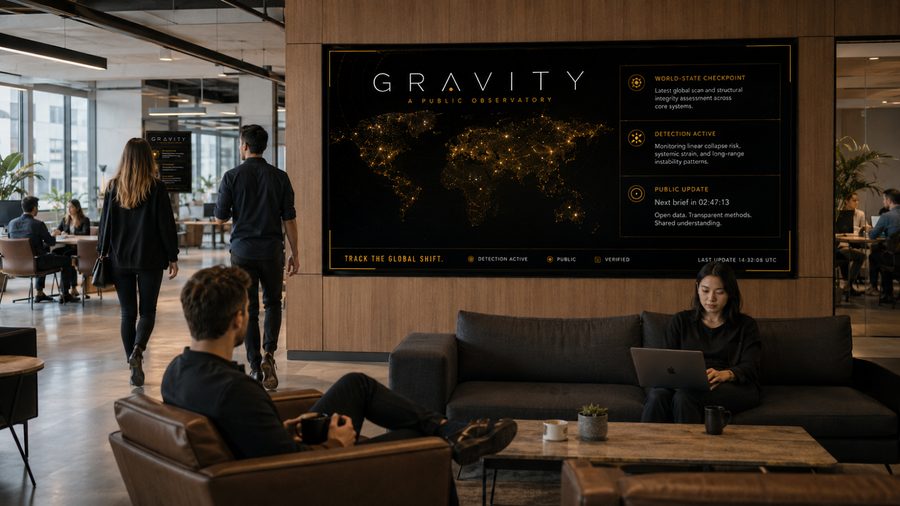
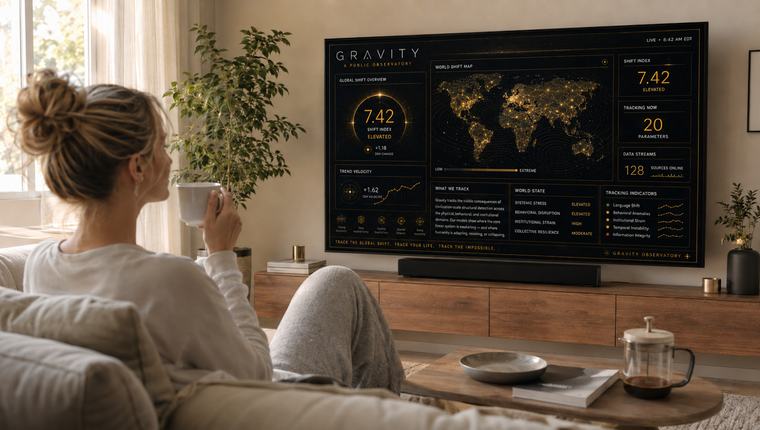
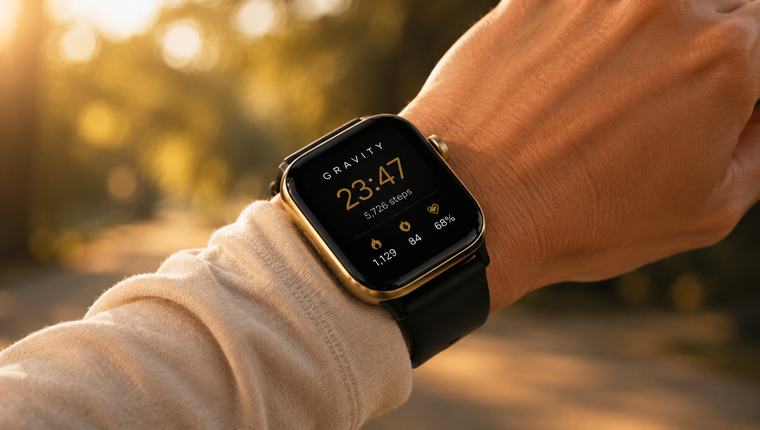
Gravity is expanding from a single public site into a wider observation system. As the detection’s fallout continues appearing across more areas of life, Gravity will release new ways to track the signal: global scans, public reports, mobile readouts, home-display formats, field tools, and additional observation surfaces.

PLANNED SURFACES: HOME · MOBILE · FIELDExpansion previews — observatory rollout 2026–2027
Access: Public · Signal: Active · Update: Weekly
GRAVITY — Radical detections detected. Public record, global scans, live readouts, field signals, anomalies, and real-time tracking.